
Andrew Kuhn June 13, 2017

A Blast from the Past: Warren Buffett’s 1977 Shareholder Letter

Whenever someone comes to me asking for advice on how to get started in investing, the first place I direct them to is reading all Warren Buffett’s Berkshire shareholder letters. It is no secret that his letters have tons of golden investing-wisdom nuggets laid upon them. I have read them many times but interestingly enough, I always take something new away from them every time I reread them. In this series, we’re going to go all the way back and start from the beginning and review all of Berkshires’ Investor letters and all the significant passages, starting with 1977; a cool 19 years before I was born.

Focus on Return on Invested Capital, instead of EPS growth

“Most companies define “record” earnings as a new high in earnings per share. Since businesses customarily add from year to year to their equity base, we find nothing particularly noteworthy in a management performance combining, say, a 10% increase in equity capital and a 5% increase in earnings per share. After all, even a totally dormant savings account will produce steadily rising interest earnings each year because of compounding. Except for special cases (for example, companies with unusual debt-equity ratios or those with important assets carried at unrealistic balance sheet values), we believe a more appropriate measure of managerial economic performance to be return on equity capital. In 1977 our operating earnings on beginning equity capital amounted to 19%, slightly better than last year and above both our own long-term average and that of American industry in aggregate. But, while our operating earnings per share were up 37% from the year before, our beginning capital was up 24%, making the gain in earnings per share considerably less impressive than it might appear at first glance. We expect difficulty in matching our 1977 rate of return during the forthcoming year. Beginning equity capital is up 23% from a year ago, and we expect the trend of insurance underwriting profit margins to turn down well before the end of the year. Nevertheless, we expect a reasonably good year and our present estimate, subject to the usual caveats regarding the frailties of forecasts, is that operating earnings will improve somewhat on a per share basis during 1978.”

Warren is talking about looking through the noise and thinking about how a business has gotten to present day. What does Warren mean by this? Well, let’s look at a disastrous investment example to illustrate.
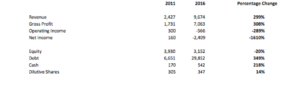
Valeant was the darling of Wall Street for quite some time, and everyone reading this blog will be familiar with what happened to them. The most alarming thing for me when I did some due-diligence on Valeant when it was in the $200’s, was their exploding debt followed by declining operating/net earnings… A true recipe for disaster. Growing revenue is good, but you want to understand how they got to where they are. The whole Valeant saga was, and still is, a case study in action. Standing from the sidelines, I have …

Read more
Kevin Wilde June 4, 2017

Wells Fargo (NYSE:WFC)

OWNERSHIP: I first bought WFC in FEB-2010. It is my top holding at 12.5% of my portfolio.

Figures as of 24-APR-2017

 SUMMARY

Wells Fargo is one of the biggest banking / financial institutions in the United States.  The company is organized into three operating segments: Community Banking which offers a complete line of financial services for consumers and small businesses (representing ~50% of earnings); Wholesale Banking which offers banking to larger businesses and government institutions (representing ~35% of earnings); and Wealth and Investment Management which offers personalized wealth management, investment, and retirement products (representing ~10% of earnings).

In general, Wells Fargo makes money in two ways.  Firstly, it earns a spread on its interest-earning assets by borrowing at low rates and lending at higher ones.  Secondly, Wells Fargo collects fees for the products and services it offers (non-interest income).  Non-interest income only partially offsets the company’s non-interest expenses; thus, it is only accretive to earnings if it outpaces costs.

Keys to banking include profitability as measured by Return on Assets (ROA), deposit growth, and leverage.  Return on assets is dependent on the cost of a bank’s interest-earning assets (primarily the size of their low-cost and non-interest bearing deposit base), the quality of the loans it makes (the frequency of loan defaults), its ability to generate non-interest income (earn fees for products and services), and its ability to keep costs down (low overhead).  Deposit growth translates into higher earnings by increasing a bank’s low cost deposit base and allowing it to earn a spread on additional loans.  Leverage is important because it can magnify both earnings and losses.

I believe Wells Fargo securities represent a safe investment.  U.S. banks are very durable businesses with high customer / deposit retention.  Most American consumers and businesses use their bank accounts for transactions and are generally indifferent to interest payments on the money they use month-to-month.  Banks could change for the worse, but changing for the better is much more likely. Traffic to branches is declining, which should lead to branch closures and cost reductions.  Wells Fargo has a strong competitive advantage built on a strong branch network, huge base of low cost deposits, conservative lending practices, and an ability to increase non-interest income by cross-selling its products.  Wells Fargo serves one-third of American households and its deposit base accounts for 10.8% of all U.S. deposits.  Credit has seldom been a problem; the bank successfully navigated severe real estate downturns in California (its largest market) in 2009, and the early 1990s, and there are no signs that the company has become a more aggressive underwriter.  The bank has earned a positive net income in each of the last 58 years (as far as I went back) and is less exposed to the risky investment banking and trading business than its peers.  The improper sales practices that occurred in Community Banking are the biggest concern because they have tarnished the bank’s reputation and suggest a problem with the bank’s culture; however, if the company implements …

Read more
Jayden Preston June 2, 2017

Under Armour (UA): A Peek at 2037

Overview


Under Armour (UA) was founded in 1995 by Kevin Plank, then special teams captain of the football team from University of Maryland. Frustrated by the increase in weight traditional cotton T-shirts incur after heavy sweating, Plank set out to develop T-shirts using better materials. After a year of fabric and product testing, he settled on a compressed synthetic shirt that can be worn beneath an athlete’s uniform. The product provides a snug fit, while wicking sweat away from the body and remaining light.


Fast forward 20+ years later, UA has seen its product offering expanded to a wide variety of apparel, footwear, accessories and so on for both men and women. UA also now sells its products globally. In 2016, UA’s revenue has reached more than $4.8 billion, becoming the third biggest sports brand in the world after growing revenue 38% p.a. since 2002. They have also started cracking the lifestyle sportswear market in 2016 by introducing a new product line called UAS.


Despite, the diversification of product lines since its inception, it’s important to remember UA is still a performance wear company. All its products are designed to have an aspect of “performance”, including the new UAS line.


Business Description, Quality and Moat


It’s probably most helpful to understand UA in the context of its two biggest competitors.


Both Nike and Adidas started out as sports footwear companies. As of 2016, both of them still generate the majority of their revenue from footwear, 53% for Adidas and 65% for Nike.


And as brands with longer histories, both Nike and Adidas are more established internationally, generating more than 50% of their revenue outside of their home markets, i.e. Western Europe for Adidas and North America for Nike.  


On the other hand, UA is much less reliant on footwear while much more reliant on its home market. With its roots in performance apparel, apparel still represented 67% of revenue for UA in 2016, with footwear at just 21%. UA’s reliance on its home market is more extreme. North America accounted for 83% of their revenue in 2016.


Despite the above two major differences, UA has displayed a remarkably similar financial profile when compared to either Nike and Adidas. First of all, all three of them have stable gross margins in the mid to high 40%. In fact, UA’s gross margin has been higher and more stable since 2002.


Stats for Gross Margin since 2002:

Company

Average

Median

S.D.

Coefficient of Variance

Under Armour

48%

48.2%

1.6%

0.033

Nike

44.1%

44.5%

1.9%

0.042

Adidas

47.1%

47.7%

1.7%

0.036


A similar picture can be found for EBIT. This time, UA’s performance has only trailed Nike.


Stats for EBIT since 2002:

Company

Average

Median

S.D.

Coefficient of Variance

Under Armour

10.8%

10.8%

1.7%

0.160

Nike

13%

13.1%

0.9%

0.070

Adidas

8%

7.8%

1.4%

0.177


The major reasons why these three companies can have high and stable gross margins are: 1) They are in the business of selling a brand, 2) they engage in …

Read more
Geoff Gannon May 30, 2017

The 3 Ways an Investor Can Compromise

GuruFocus: Pick the Winners First – Worry About Price Second

“There are 3 ways an investor can compromise:

1.    He can compromise by paying a higher price than he’d like to

2.    He can compromise by buying a lesser quality business than he’d like to

3.    He can compromise by not buying anything when he’d rather own something

You could use these 3 compromises as a test of what kind of investor you are.

A growth investor – like Phil Fisher – compromises by paying a higher price than he’d like. He won’t compromise on quality. So, he has to compromise on price. A value investor – like Ben Graham – compromises by purchasing a lower quality business than he’d like. He won’t compromise on price. So, he has to comprise on quality. Finally, a focus investor – like me – compromises by not owning any stock when he’d much rather be 100% invested.”

GuruFocus: Pick the Winners First – Worry About Price Second

Read more
Geoff Gannon May 29, 2017

Over the Last 17 Years: Have My Sell Decisions Really Added Anything?

I get a lot of emails from people saying that my strategy has changed – I’ve become more of a growth investor and less of a value investor – over time.


It’s true that the investments I’ve made in recent years have definitely changed.


But, my philosophy has changed less than it would appear from my stock picks. I concentrate heavily and go where I see opportunities I consider “nearly certain” rather than being the highest return opportunities based on pure probabilities.


There is, however, one area where my philosophy really has changed:


I’m convinced that I should simply hold stocks indefinitely.


Why?


Let’s start with two spin-offs I bought. One spin-off happened 2 years ago. The other spin-off happened a little over 10 years ago.


First, the 2-year-old spin-off. I have 25% of my portfolio in BWX Technologies (BWXT). I bought that as part of a spin-off from Babcock & Wilcox. The stock has returned more than 30% a year in the two years since the spin-off. It now trades at a P/E of 26. Normally, this is when a value investor would sell the stock. However, I think the company can grow earnings per share by 10% a year for the next several years. I also think a company of this quality should always trade at a P/E no less than 25. So, with no new ideas that seem more likely to deliver returns of 10% a year or better – I have no intention of selling BWXT. With the catalyst from the spin-off gone and the P/E above 25 – no value investor would keep holding this stock. But I intend to. Does that mean I’m not a value investor?


It might mean that. But, it also may just mean I learned from the last spin-off I liked a lot.


About ten years ago, I picked a spin-off called Hanesbrands (HBI). Here’s a quote from a roundtable discussion I did back in 2006 (share prices are not adjusted for subsequent splits):


However, there are many situations (and here is usually where you find some bargains) where the EV/EBIT measure is not the most useful. When I can predict a high free cash flow margin with confidence, I use a very long-term discounted cash flows calculation. For instance, this is what I would do with Hanes Brands which was recently spun-off from Sara Lee. On an EV/EBIT basis, it may not look cheap. But, looking truly long-term, I’m convinced the intrinsic value of each share is much closer to the $45 – $65 range than the roughly $23 a share at which it now trades. But, that’s a special case – Hanes is a special business.”


I gave that quote back in October of 2006. Hanesbrands stock has compounded at 12% a year in the 10 years since I made that comment (it’s compounded at 15% a year since the actual spin-off date).

 …

Read more
Geoff Gannon May 29, 2017

I’ve Decided to Stop Deciding Which Stocks to Sell

Over the Last 17 Years: Have My Sell Decisions Really Added Anything?

“The stocks I pick don’t benefit much from well-timed sales. There’s usually little harm in holding on to them much, much longer than I do.

So, I’ve decided to hold the stocks I own indefinitely. When I find a really, really good stock idea – which might happen once a year – I will need to sell pieces of the stocks I already own to raise cash for that purpose. I’ll do that. So, if I’m fully invested and want to put 20% of my money into a new stock – I’ll have to sell 20% of each stock I now own. But, I’m not going to eliminate my entire position in a stock anymore. Those decisions to completely exit a specific stock haven’t added value for me. So, I’m not going to try to make them anymore.

From now on, I’m going to be a collector of stocks.”

Over the Last 17 Years: Have My Sell Decisions Really Added Anything?

Read more
Geoff Gannon May 26, 2017

Reflections on the Newsletter: Why Quan and Geoff Wrote Those 27 Stock Reports

Focused Compounding includes a “Library” with 27 stock reports. I co-wrote those stock reports with Quan Hoang between 2013 and 2016. Although Quan and I no longer work together, he agreed to put his thoughts on that experience in writing for our community members to read. I think reading Quan’s “Reflections” will help you put each of those 27 reports in better context.


Quan’s Reflections

Geoff asked me to write a reflection on my experience writing The Avid Hog (a newsletter we later renamed Singular Diligence). So in this post, I’ll share my experience and show why I believe stronger than ever that long-term investing is the best path to wealth.

Geoff and I started our venture in 2012. Initially we had been hired to start the research arm for a financial company. Right after my college graduation, I flew to Plano and was eager to work in person with him, who to me is like Ben Graham (or Phil Fisher) to Warren Buffett. However, due to some disagreement with our employer over the product we were developing, Geoff decided to quit. That night by a pond near both our apartments, Geoff told me that he was about to turn 28 and he did not like doing the job that he didn’t like just to find several years later too late to switch. He asked if I wanted to quit and partner with him. That was exactly my plan when I knew he quit because learning from him was the only reason I went to Plano.

So we start our venture without a clear direction. We just wanted to write a newsletter. I imagined that would be the best learning process for me. I would do in-depth research every day and my knowledge would compound. If I did a good job, the newsletter would bring in cash flow for me to invest and I could be financially independent. Even if the newsletter did not make money, I would still learn a lot. I was young and determined to become a great investor. I didn’t see any job that could truly train me as an investor (and I still don’t see today.) That’s also the reason why there are so few good investors. Most students are obsessed with getting a job. Investment banks would train you to be a next-quarter forecaster, not an investor. Most investment funds don’t have the right investment framework and spend most of their time watching the wrong kind of information. In general, once one gets a job (finance-related or not), he will enter a rat race, leaving them no time to seriously practice value investing. I didn’t like that path. I was young and I was willing to invest my time.

From that day on, I would go to Geoff’s apartment each day. We started by writing blog posts regularly to connect with our audience. That was the bad part of each day. I don’t like writing and I always struggle to find ideas …

Read more
Geoff Gannon May 26, 2017

The Fastest Way to Improve as an Investor

  1. Study a series of related stocks.
  2. Give each stock your absolute undivided attention – focus like you’ve never focused before (it’s fine if you can only do this for like 45 minutes at a time).
  3. Put your thoughts into writing.
  4. Bounce those ideas off another person.
Read more
Andrew Kuhn May 25, 2017

The Punch Card Mindset

“I could improve your ultimate financial welfare by giving you a ticket with only twenty slots in it so that you had twenty punches–representing all the investments that you got to make in a lifetime.  And once you’d punched through the card, you couldn’t make any more investments at all.  Under those rules, you’d really think carefully about what you did and you’d be forced to load up on what you’d really thought about.  So you would do so much better.”- Warren Buffett

Many Buffett and Munger pupils preach following the “punch card mindset,” yet very few actually do. I really think applying this filter has made all the difference for me in my evolutionary process as an investor, and I’m quite confident it will dramatically improve your results as well; especially if you are striving to be a focused investor like Geoff and myself. What does following the punch card mindset mean to me? It means doing the due-diligence required to get to a level of certainty that you are willing to put 20%+ of your net worth in a single idea. It means not succumbing to the daily irrational swings of Mr. Market, and being able to stick to your original thesis if nothing fundamentally has materially changed within the business. It means not laying out capital unless you feel like the odds are so heavily in your favor that heads, you’ll make money, or tails, you can at least break even or not lose that much. It is easy to talk the talk, but actually putting it into practice can be much more challenging, as It should be. After all, why should It be easy to become rich?  You need to be okay with the fact that not every stock you look at will be a punch card worthy investment. Logically speaking there would be no such thing as the punch card mindset if so. Success in investing to me is saying no a lot more than you say yes. The best part about investing though is even if you say “no” to an idea, the amount of work you did to get to that decision can be extremely useful to you. Everything in investing is all cumulative. All knowledge stores up like compound interest. So even if you feel like you are not getting anywhere because you are not finding any actionable ideas, trust me, you are. Just keep your head down and keep chugging along.

“The most important three words in investing may be: “I don’t know.” Having strong viewpoints on a lot of securities, and acting on them, is a sure-fire way to poor returns in my opinion. In my view, it’s easier to adopt this “I don’t know” ethos by focusing on the business first and valuation second, as opposed to the other way around. I’ve found that when valuation is the overriding driver of interest, I’m prone to get involved in challenging businesses or complicated ideas and liable to confuse a

Read more
Geoff Gannon May 22, 2017

The First 8 Things to Look at When Researching a Stock

The other day, someone I talk stocks with on Skype asked how I normally go about starting my initial research into a stock. What documents do I gather?

Here’s what I said:

“Basically, I start by finding the longest series of financial data I can (GuruFocus, Morningstar, whatever) and then look at that along with reading the newest 10-K and the oldest 10-K in detail. So, 10-year+ financial data summary, 20 year old 10-K (or whatever), this year’s 10-K, and then the investor presentation if they have one, and the going public/spin-off documents if that’s online. Also, I read the latest proxy statement and the latest 10-Q as needed for info on management, share ownership, the balance sheet etc.”

I also check the very long-term performance of the stock. So, I will chart the stock – at someplace like Google Finance – against the market over a period of 20, 30, or 40 years.

So, here’s a full list of my usual sources:

1.       Check long-term stock performance (what is the compound annual return in the stock over 20, 30, or 40 years?)

2.       Find the longest series of historical financial data possible (search for a Value Line sheet, a GuruFocus page, or go to Morningstar or QuickFS.net to see the long-term financial results)

3.       Read, highlight, and take notes on the latest 10-K (so 2016)

4.       Read, highlight, and take notes on the oldest 10-K (On EDGAR, this is usually around the year 1995)

5.       Read, highlight, and take notes on the company’s own investor presentation

6.       Read, highlight, and take notes on the IPO or spin-off documents (On EDGAR, this will be something like an S-1 or 424B1)

7.       Read, highlight, and take notes on the latest proxy statement (On EDGAR, this will be something like a DEF14A)

8.       Read, highlight, and take notes on the latest 10-Q.


Why Check the Long-Term Stock Performance?

This is something a lot of value investors wouldn’t think of. But, I find it very useful. Any time you are looking at a stock’s performance your choice of start date and end date are important. The good news is that your start date will be fairly arbitrary if you just look as far back as possible. So, if the stock has 27 years of history as a public company – and you look back 27 years – you probably aren’t picking a price near an unusual low point in the stock’s history. In fact, you’re probably picking the IPO price, which will rarely have seemed a “value” price at the time. The other good news is that – as a value investor – you’re probably attracted to stocks that seem cheap now. They trade at low or at least reasonable multiples of earnings, EBITDA, sales, tangible book value, etc. This means that any stock you are looking at as a possible purchase is unlikely to be benefiting right now from a particularly good choice of an end point.

Here’s an example.

If …

Read more