Geoff Gannon September 21, 2017

He Who Has the Highest Opportunity Cost Wins (CAKE, NC, GRBK)

Someone who reads the blog emailed me about Cheesecake Factory (CAKE):

Why are you not buying CAKE – it is around 66 cents on the dollar – at 40 dollars (a share)?”

When I answered that to his satisfaction, he asked:

“…So your options right now are most likely OMC, Howden and CAKE? You said in your OMC (stock report) that it was the best business you’ve ever analyzed. Is that still the case, especially compared to CAKE etc.?”

Omnicom is a better business than Cheesecake. However, Cheesecake may have more room to deploy capital within the business for the next 5, 10, 15 years. Apparently, Cheesecake management still thinks they can grow the concept from 200 locations to 300 locations. It’s not unheard of for them to open 8 new restaurants a year. So, that’s probably equivalent to 3% compound annual growth in the number of Cheesecake locations over a period of 10-15 years. Each location may be capable of earning a 10% to 15% after-tax return on the company’s cash investment of say $8 million to $12 million (they also sign a lease, but this does not tie up any shareholder money). Let’s call it $10 million per location in cash the company puts in and they can repeat that same $10 million bet at each of another 100 new locations – that’s $1 billion more in reinvestment done at rates of 10% plus.

To put this in perspective: Cheesecake may be able to re-invest 50% of its current market cap over the next 10 years at rates of return equal to or greater than 10% a year. It can also buy back its own stock. Both companies can do that and I expect both will do that aggressively. But, Cheesecake may have this additional opportunity to invest about 50% of its market cap over the next 10 years in the actual business at good rates of return. For Omnicom to reinvest 50% of its market cap on those same terms, there would need to be something in the $8 billion to $9 billion price range that will earn a year one 10% plus cash return on your investment.

I don’t see how Omnicom can find something like that. Right now, Omnicom can only compete with that kind of value creating capital allocation by buying back its own stock. Omnicom’s stock would have to stay cheap for a long time while the company gobbled up its own shares for OMC’s capital allocation to add as much value as Cheesecake’s capital allocation. So, Cheesecake may grow intrinsic value per share faster than Omnicom. Omnicom’s still the safer bet if you had to own one stock forever. But, if you have to own one stock for the next 10 years – I can’t promise that OMC has a way to deploy as much cash as profitably as Cheesecake might. Again, I stress might (CAKE needs to find good mall type locations to do this).

My options …

Read more
Andrew Kuhn September 20, 2017

Warren Buffett’s Partnership Letters and My Investing Thought Process

“You can’t predict. You can Prepare.”
-Howard Marks

I have been reading all of Warren Buffett’s old partnership letters the past week or so. These letters are the letters he wrote to his Investors yearly (and then semi-annually) from 1957- 1970 before winding down his partnerships to eventually run Berkshire. I was inspired to do so because I have also been rereading The Snowball by Alice Schroeder’s for the past month, and it’s awesome how it takes you back to the beginning and goes year by year in Warren’s life as the snowball was building up and starting to roll downhill. There are a few books I re-read every year, and The Snowball is one of them. (Also on that list is Poor Charlies Almanack, another book I highly recommend.) The partnership letters are too long to embed in this post, but if you go to this link you should be able to pull them yourself:

http://csinvesting.org/wp-content/uploads/2012/05/complete_buffett_partnership_letters-1957-70_in-sections.pdf

Although Warren invests completely differently now, there are still a lot of takeaways you can pull for yourself from his writings. One thing I found interesting is on page 20 in his 1961 letter where Warren goes over his different types of Investment Categories. I’ll let him explain:


“The first section consists of generally undervalued securities (hereinafter called “generals”) where we have nothing to say about corporate policies and no timetable as to when the undervaluation may correct itself. Over the years, this has been our largest category of investment, and more money has been made here than in either of the other categories. We usually have fairly large positions (5% to 10% of our total assets) in each of five or six generals, with smaller positions in another ten or fifteen. Sometimes these work out very fast; many times they take years. It is difficult at the time of purchase to know any specific reason why they should appreciate in price. However, because of this lack of glamour or anything pending which might create immediate favorable market action, they are available at very cheap prices. A lot of value can be obtained for the price paid. This substantial excess of value creates a comfortable margin of safety in each transaction. This individual margin of safety, coupled with a diversity of commitments creates a most attractive package of safety and appreciation potential. Over the years our timing of purchases has been considerably better than our timing of sales. We do not go into these generals with the idea of getting the last nickel, but are usually quite content selling out at some intermediate level between our purchase price and what we regard as fair value to a private owner. The generals tend to behave market-wise very much in sympathy with the Dow. Just because something is cheap does not mean it is not going to go down. During abrupt downward movements in the market, this segment may very well go down percentage-wise just as much as the Dow. Over a period of …

Read more
Kevin Wilde September 18, 2017

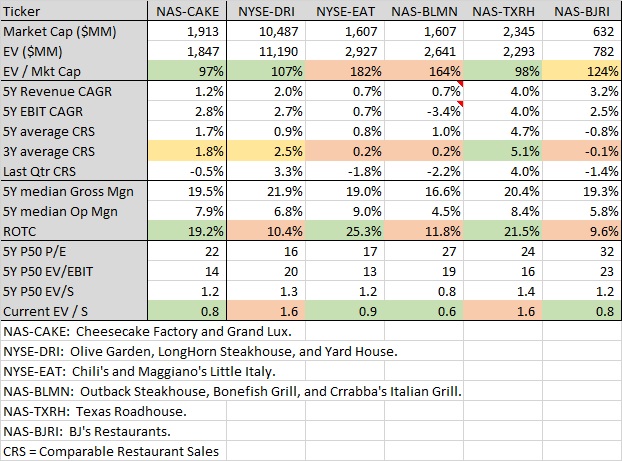
Cheesecake Factory (NAS:CAKE) Comparative Analysis

Read more
Geoff Gannon September 17, 2017

Frost (CFR): Interest Rate Expense and Cyclically Adjusted Earnings

A reminder: 40% of my portfolio is in Frost. It’s the stock I like best.

Someone wrote me to ask about Frost’s interest expense:

“Hi Geoff,

I have not read your report on Frost…but right now I am looking at the latest balance sheet and (am) very  surprised…the average interest expense is…paltry…the cost of funding is 0.032%. That’s extremely low, almost free. Am I right on this calculation? Or is it a mistake?”

My response goes into way more arithmetic than anyone wants to read. But, if you want the full picture of how I personally value Frost – read on…

First of all, a bit more than half of Frost’s deposits are in accounts that pay pretty close to 0% interest because they provide a lot of services and these customers are not hunting for yield. Frost pays “credits” to reduce the fees customers are charged for banking services. I think when we wrote our report it was about 1.5% combined interest and non-interest expense. Frost generally has the lowest non-interest expense of a bank I know of. They’re always a little lower than Wells Fargo (WFC).

Anyway, I did the calculation for last year’s interest expense that you did using average interest bearing deposits and annual interest paid on those deposits (the information is in the 2016 10-K at EDGAR). They paid 0.03% on average in interest (3 basis points). Which is what you said. However, remember, the Fed Funds Rate started 2016 at 0.25% to 0.50%. So, the 2016 interest rate expense for any bank is very misleading.

In the long-run, I expect Frost to pay 0.5 times what the Federal Reserve pays for the same amount of money. So, if we end this year at say a 1.5% Fed Funds Rate and then it just stayed there, I’d expect Frost’s interest expense to rise to 0.75% eventually.

The formula:

FFR * 0.5 = Frost’s interest expense is pretty accurate.

That’s only the cash interest rate though.

On some accounts, Frost also pays an “earnings credit rate” that customers use to offset fees for services the bank would otherwise charge for. So, back in 2016, Frost might have been paying 0.03% on an account in cash interest but then 0.25% in credits you can use to offset bank fees.

Of course, it’s the total expense that matters for a bank. You have to count both the interest expense and the net non-interest expense when calculating cost of funds. Frost pays maybe 1.4% of deposits in net non-interest expense and then you have the interest expense.

So, the bank’s total economic cost of funding would really be:

FFR * 0.5 + 1.4% = Frost’s total cost of funding.

So, if we end 2017 at a 1.5% Fed Funds rate and the rate stayed there, Frost should be getting their money at about 0.75% (interest expense) + 1.40% (net non-interest expense) = 2.15%.

If the Fed Funds Rate was a more “normal” 3% to 4%, then Frost’s …

Read more
Geoff Gannon September 17, 2017

Are You Buying Anything Now?

A blog reader emailed me this question:

“Are you buying anything now?”

No. I still haven’t bought a stock this year.

I like Cheesecake Factory (CAKE) a lot. There’s a write-up in the Focused Compounding member idea exchange about it. If I was to buy something right now, it would probably be CAKE. It’s a good business facing a temporary problem. Over the last two years, “food away from home” (at restaurants) is up 5% in price while “food at home” (supermarkets) is down 1.6% in price. So, the relative cost of eating out versus eating in has changed 6.6% in the last 2 years in the U.S. As economic theory would say has to happen, value seeking households have done some substituting from eating out to eating in. This has caused a decline in same store sales. The Cheesecake Factory’s same store sales are down 1% this year. The stock is down 32%. I had researched the business previously. CAKE shares were probably about fairly valued at the start of this year ($60 then vs. $40 today).

I would consider buying Omnicom (OMC) at about $65 a share. It’s at $73 a share now.

And you know I like Howden Joinery and continue to follow that stock as a possible purchase as well.

Not that long ago, I dropped everything and looked intensely at AutoZone (AZO) when it plunged just under $500. It’s at $570 now. I liked what I saw. At $500 a share, I think AutoZone would make sense as a “value” stock (really more of a cannibal that grows EPS through buybacks). But – for me at least – it’s the kind of stock you’d want to buy now and sell in 3 years or whenever its multiple expands again instead of holding forever.

I’ve looked at other companies recently, but have not bought any.

I looked at Howard Hughes (HHC) this past week. The company still owns a lot of valuable land in high-end master planned communities like Summerlin, Nevada (about 10 miles from the Vegas Strip) and is developing commercial real estate at the South Street Seaport in Manhattan and Ward Village (about 3 miles from Waikiki Beach in Honolulu). It has nice assets. It doesn’t seem obviously overpriced (before I looked, I expected it would be). But, I can’t prove it’s cheap. I’m only able to come up with estimates for some of HHC’s assets. Not all. I can’t imagine ever being able to come up with a solid appraisal value for the whole company.

I plan to look at Green Brick Partners (GRBK) and LGI Homes (LGIH) this week. They build homes here in Texas and elsewhere.

The only U.S. stocks that show up on Ben Graham type screens right now are a lot of retailers and some homebuilders. There’s literally nothing else here in the U.S. that’s quantitatively cheap anymore.…

Read more
Geoff Gannon September 17, 2017

5 Stocks Ben Graham Would Buy

In an earlier post, I said that the only stocks in the U.S. showing up on Ben Graham type screens right now are retailers.

Here are 5 of those retailers:

(All numbers are taken from GuruFocus)

What do I mean when I say a Ben Graham screen?

There are three ways to go with this. A “Ben Graham screen” could mean: A) a screen that uses a single, specific formula Graham developed (like a net-net screen), B) a screen that uses a checklist that Ben Graham laid out for investors in one of his books (like the criteria he lists for “Defensive Investors” in “The Intelligent Investor”), or C) a screen that tries to duplicate the approach Ben Graham used in his own Graham-Newman investment fund.

Here, I chose “D” which I would define as adhering to the “spirit” of Graham rather than the letter of any Grahamite law.

What do I consider the spirit of Ben Graham?

1.       Don’t pay too high a price relative to a stock’s earnings (eliminate high P/E stocks)

2.       Don’t pay too high a price relative to a stock’s assets (eliminate high P/B stocks)

3.       Don’t buy stocks with a weak financial position (eliminate low F-Score stocks)

4.       Don’t buy unproven businesses (eliminate stocks that either lost money or didn’t exist sometime within the last 15 years)

5.       And needless to say: don’t buy into frauds (eliminate U.S. listed stocks that operate in China)

If you apply those 5 filters to all U.S. listed stocks, you’re left with just 5 stocks:


These are all retailers. And, obviously investors are concerned that Amazon and others will put offline retailers out of business. Do I think Ben Graham – knowing internet retailers were coming for these stocks – would buy a basket of these 5 retailers today?

I do.

The Warren Buffett of the 2010s wouldn’t. But, the Ben Graham of the 1950s would.

The reason I’m so sure Graham would buy these 5 stocks if he were alive today is that they all share the same exact value proposition. The bear case is speculative (future oriented). The bull case is historical (past oriented).

Graham’s approach was always to bet on the basis of the past record you do know and against the future projections you don’t know.

The quote he opened Security Analysis with is from the Roman poet Horace:

“Many shall be restored that now are fallen; and many shall fall that are now in honor.”

These 5 stocks are all fallen angels. In almost all past years, they were valued more highly than they are today. They are the common stock equivalent of junk bonds.


Hibbett Sports (HIBB) – P/E 7, P/B 0.9, F-Score 6

Hibbett Sports runs small format sporting goods stores in mostly rural America. The best way I can sum this up is that if you drive through an American town where Wal-Mart is the main retail destination for just about anything, there will be a Hibbett

Read more
Geoff Gannon September 16, 2017

Frost (CFR) in Barron’s: Read My Interview about Frost and My Report on Frost

Some blog readers emailed me to say this week’s Barron’s did a piece on Frost (CFR). If you read that piece and are looking for more about the bank you can:

Read my interview with Punch Card Research about Frost

Read the report I did on Frost

Frost is my biggest position. It is around 40% of my portfolio.

The stock’s price is now a little under $90 a share. In a “normal” interest rate environment, I think it’d be worth $150 a share.

Of course, it could be a while before interest rates are normal.…

Read more
Kevin Wilde September 14, 2017

Cheesecake Factory (NAS:CAKE)

The Cheesecake Factory (NAS: CAKE)

14-SEP-2017 (EV $1.82B; Mkt Cap $1.88B; 49.0MM shares outstanding; $40.29/share)

STATUS

  • At end of 2016, CAKE had a total of 208 company-owned restaurants (all U.S. based):
    • 194 Cheesecake Factory restaurants
    • 13 Grand Lux
    • 1 Rock Sugar Pan Asian
    • NOTE: Each restaurant has sales of ~ $10.5 annually. Maintenance CapEx over the last 3 years has been between $26MM and $29MM per year.  Bakery & Training center capex has averaged $11MM annually over the last 3 years.
  • 2016 sales of $2.276B.
  • Highly consistent operating margins with 25-year weighted average of 8.0%.
  • Consistently convert 150% of operating income into Cash Flow from Operations.

GROWTH

  • At end of 2016, CAKE also had 15 international locations owned by licensees.
  • In the past:
    • Opened between 8 to 10 new restaurants in the past 5 years @ average cost of $8.0 to $10.5MM per location.
    • Have closed ~ 4 restaurants in the past 5 years (1x Cheesecake Factory + 3x Grand Lux).
    • 15-year median comparable restaurant sales 1.2%.
  • Going forward:
    • CAKE believes that there is room for >300 U.S. company-owned Cheesecake Factory locations.
    • Current plans call for 8 company-owned Canadian locations.
    • CAKE expects to add 3 to 5 international licensed restaurants / year for the foreseeable future.
    • CAKE has an investment in new concept restaurants North Italia and Flower Child; however, I don’t currently put any value on these opportunities because they are an unproven concept.
    • CAKE is also looking at expanding its consumer goods sales and a fast casual restaurant concept; again, I don’t put any value on these opportunities at this time.
    • Expect costs for 8 new company-owned restaurants (ie. Cheesecake Factory + Grand Lux in U.S. & Canada) each year @ $10.5MM each for a total of $84MM; however, expect to only net 7 more restaurants per year due to restaurant closures of 1 per year.
    • Expect revenue / net earnings / free cash flow benefit of 4 new licensed restaurants per year ($0.01 EPS/restaurant * 4 restaurants * 49MM shares = ~$2MM /year) at $0 capex per restaurant.
  • GROWTH SUMMARY:
    • Within 5 years, CAKE should net 35 new company-owned restaurants at an annual capex cost of $84MM. These stores should add sales of $367MM by the end of the 5-year period.
    • Over the next 5 years, same restaurant sales should increase to $2.415B ($2.276B * 1.012^5).
    • Within 5 years, CAKE should add ~20 new licensed restaurants at $0 capex which add $10MM to FCF.

VALUE

  • Sales in 5 years time should total $2.828B (CHECK: 4.4% annual increase is in line with the recent past).
  • Operating Income in 5 years time should total ~$225MM.
  • CFFO in 5 years time should total ~$340MM.
  • New restaurant capex of in 5 years time should be ~$90MM. Maintenance capex in 5 years time should be ~ $50MM.  Working Capital effects should be negligible.  After-tax stock based compensation is likely to ~ $15-20MM in 5 years time.  Hence, free cash flow in 5 years time should be ~ $180MM.
  • CAKE is an above
Read more
Geoff Gannon September 6, 2017

Why Ad Agencies Should Always Buy Back Their Own Stock

Someone who’s been reading my blog for the past few years emailed me this question:


“With (Omnicom), I particularly like the durability of the advertising agency industry, the nature of the customer relationship (long term in nature and high retention rate), it operates in a rational duopoly environment and good capital allocation policy of John Wren. I also like WPP which also looks attractively valued at around £14 but I prefer OMC as it uses the excess cash to buy back its shares compared to WPP’s acquisitive approach. Would be great to get your thoughts and insights on the following:


– Any significant misjudgment I should consider that could potentially impair OMC’s ability to compound by around 10% in the long term;


– Your thoughts on WPP as a potential alternative consideration to OMC, especially at the current price of around £14 and its market leadership. I like OMC even more now that it is in the low $70s but it would be interesting to get your take on your appraised value of WPP and if there are factors I should favour WPP over OMC apart from the valuation margin of safety and different use of excess cash (share buybacks versus acquisition).”


No. There’s no significant misjudgment on your part that’s going to cause Omnicom to fail to compound at 10% a year while you own it. I’ve looked at ad companies recently and don’t see any changes in the industry that worry me. I’ve gotten a lot of emails – and responded to some of them – about whether ad companies will have a narrower “moat” in the future than they have in the past. I think the concerns are very speculative. And I don’t see any long-term reason for the decline in the share prices of ad companies like WPP and Omnicom.


Obviously, there are cyclical reasons that explain these price declines well.


The big change in advertising is that Google (both the search engine and YouTube) and Facebook are the venues where all incremental ad spending in the world is now going. So, Google and Facebook will have a big share of ad spending in the future. But, that’s not new. Brands have often spent a large portion of their ad budgets at a small number of media outlets.


The new part is that global conglomerates (like Omnicom) made up of different agencies will be doing a lot of their overall buying for clients at just two corporations: Facebook and Google.


I understand it worries other people. It doesn’t worry me. I don’t see anything in the way that the ad industry is developing now that seems like a bigger shift than the rise of TV, the death of newspapers and magazines, or the rise of the internet. Those things already happened by the way. It would be impossible to know that from looking at the financial results of global ad companies. None of those events left the slightest mark on …

Read more
Geoff Gannon September 6, 2017

Hold Cash: Wait till You Get Offered 65 Cents on the Dollar

A Focused Compounding member who fears the stock market is expensive posted this comment:

“Hi Geoff,


S&P today is expensive based on TTM PE of 24 and CAPE of about 30. An investor whose holdings consist entirely of stocks outside S&P500, will still see a drop in the prices of her equities if the S&P falls even if she has bought her holdings significantly below their estimated fair values. In your opinion, what’s the best way to position oneself going forward with the goal of course being total portfolio returns outpacing market returns in the long run?


  1. change to 100% cash position (to take maximum advantage of potential future price drop)
    2. 20% or so equities and about 80% cash (so as to take advantage of potential price drop)
    3. Ignore the market completely and keep current balance of about 80% equities, 20% cash
    4. Any other thought besides the above three.”


The option that comes closest to what I’d suggest is #3 (“Ignore the market completely and keep current balance of about 80% equites, 20% cash”).

But, let’s walk through why that is.

First, do I think the market is expensive?

Yes.

In an August 29th post, entitled “The Market is Overpriced: These 3 Stocks Aren’t” I wrote:

“I’ve never seen a time when it’s as difficult to find a good stock to buy without overpaying as what I see right now.

But, I don’t think that means you should be 100% in cash. I think it means you should be in stocks like:

Cheesecake Factory (at $41 as I write this)

Omnicom (at $73 as I write this)

And Howden Joinery (at 412 pence as I write this)

If the market as a whole is overpriced, it will fall. And when it does fall: it will take stocks like Cheesecake, Omnicom, and Howden with it.

In time, they will recover.

And you will be able to look back – 5 years or more down the road – and say that buying stocks like these at today’s ‘not overprice’ levels and holding them wasn’t a mistake.

You don’t need to get out of the market.

But, you do need to be more selective than ever now that the market is more expensive than ever.”

The second question is: how have I positioned my own portfolio?

My account has 30% in cash right now. I expect that to rise to 35% sometime soon (when I sell a small position).

My 30% to 35% cash position is not a market call. I’m going to spend the rest of this article explaining what it really means when you see me holding cash.

With most investors, a 30% to 35% cash levels means they have thought about portfolio allocation and decided that 30% to 35% in cash is a good level to be at right now because of the risk level in the overall market.

For me, that’s not true.

The truth is that I like two stocks – …

Read more